
The ongoing argument about whether artificial intelligence is damaging search results overlooks the main issue in modern publishing: search engines and readers do not reject AI because of the software used to create it. They reject content that lacks substance, clarity, and value. The idea that machine assistance automatically causes a penalty is one of the most common misunderstandings in digital marketing today. The real divide has never been between human keyboards and computer systems. It is between useful, thoughtful resources and empty noise.
The facts are more detailed than simple labels suggest. As Rafał Moszkowcow Chomsky puts it: “Google does not uniformly reward AI content or punish human content. I have seen AI articles cited by Stanford rank while better human pieces were deindexed.“
Search systems focus on whether a page answers the searcher’s question accurately, reliably, and fully. They do not care how many computer chips or human hands helped assemble the sentences.
AI Content Isn’t the Problem-Low-Quality Content Is
For many years, publishers have searched for shortcuts to satisfy ranking systems. This has produced countless pages built to capture search traffic rather than help readers. Artificial intelligence has made this process faster, increasing both useful research and poor-quality clutter. When site owners fill the internet with generic, repetitive writing, the problem is not the language model. The problem is the decision to publish material that does little for the reader.
Good content still depends on clear intent and careful work. An AI prompt guided by an experienced specialist, with every fact checked and original analysis added, can produce a highly useful article. By contrast, a rushed freelance writer told to rewrite ten competitor pages in one afternoon will likely create dull, copied filler. The production method matters less than the editorial care behind the final page.
What Google Evaluates: Usefulness, Originality, Accuracy, and Trust
Google’s ranking systems try to reflect how satisfied people are with search results. Instead of grading a page based on the software used to write it, Google looks at how well the page meets the searcher’s goal. Its systems look for signs of usefulness. Does the guide answer the question fully, or does the reader return to the results page to find a clearer answer? Originality also matters. A page should offer new ideas, a different view, or new data instead of repeating other pages.
Accuracy and trust are also central to Google’s review process, especially through E-E-A-T: Experience, Expertise, Authoritativeness, and Trustworthiness. A page filled with unsupported statements, unclear advice, or wrong technical details will quickly lose ground. Search systems pay close attention to reliability. Can readers trust the advice? Does the publisher show the knowledge and credentials needed to speak about the subject?
Low-Quality Content Can Be Human-Written or Ai-Generated
Long before generative models became common, the internet was full of poor human-written content. Thin affiliate websites, weak list articles rewritten from Wikipedia, and keyword-stuffed pages were all created by people trying to manipulate search rankings. Marketing discussions often idealize human writing while ignoring the fact that rushed human content has harmed search quality for more than two decades.
Bad content usually lacks useful detail, proper research, and concern for the reader. An automated tool can create broad paragraphs in seconds, but human writers working under unrealistic quotas often produce the same kind of fluff. Quality comes from clear thinking, subject knowledge, and practical usefulness. None of these qualities belong only to human writing or machine-generated text.
Google’s Position on AI-Generated Content
Search engines have moved beyond the quick assumption that automation is always harmful. In the early days of search, automation often meant scraped websites, spun text, and artificial link networks. Modern search systems recognize that machine help is now part of nearly every digital process, including spelling correction, translation, transcription, and research.
Google’s stated position has stayed consistent: judge the finished content, not the tool used to make it. Search still aims to show the most relevant and dependable information available. Whether information was typed, transcribed, or drafted by software matters much less than whether it answers the searcher’s question accurately and shows real knowledge.
Is AI Content Against Google Search Guidelines?
Google’s official guidance, shared on February 8, 2023, by Danny Sullivan and Chris Nelson for the Google Search Quality team, explained that automation, including AI, does not break search guidelines. Automation has supported useful publishing for many years. It helps produce sports scores, weather reports, stock updates, and video transcripts without damaging the quality of search.
Google’s position is that AI use brings no automatic ranking benefit and no automatic penalty. AI-generated material is treated as content. If it shows the main qualities of E-E-A-T and helps users, it can perform well in search results. Google advises publishers to review their work by asking “Who, How, and Why”: who created or checked the material, how it was produced, and most of all, why it was created.
How the Helpful Content System Evaluates AI-Assisted Pages
Introduced in 2022 and later added to Google’s main ranking systems, the helpful content system looks at whether a page was made mainly for people or mainly for search engines. It looks beyond individual keywords and checks whether the page meets the reader’s needs. Pages that leave readers informed and confident can gain visibility, while sites full of shallow pages made mainly to attract clicks can lose it.
For AI-assisted pages, the system looks for added value. If an AI draft simply repeats the first three search results with slightly different wording, it offers little that is new. But if an AI-supported article arranges difficult information clearly, adds checked examples, and provides useful conclusions that save readers time, search systems can view it as helpful.
When AI-Generated Content Becomes Search Spam
Automation becomes search spam when its main purpose is to manipulate rankings. Google’s spam policies prohibit using automation or generative models to create large numbers of pages aimed at long-tail keywords without adding original value. Google calls this scaled content abuse.
Google uses SpamBrain, an AI-based spam system, to find patterns linked to mass-produced and manipulative text. The March 2026 core update reinforced these limits. Websites that depended on large programmatic networks without human review saw traffic losses of 50% to 80%. Content created only to exploit ranking systems can lead to spam actions, no matter which software produced it.

What Makes AI-Assisted Content Low Quality?
Generative models are statistical systems trained to predict the next likely word or token from patterns in their training data. This lets them produce smooth prose, but it also creates specific factual and structural weaknesses when nobody checks the output. Any content team that wants to maintain high standards needs to understand these weaknesses.
Experts can often spot the problems in unchecked AI writing. The signs include broad generalizations, repeated transitions, and too much safe, middle-of-the-road advice. When teams fail to question and improve the output, the finished articles show clear signs of weak quality.
Mass-Produced Pages With Little Original Value
The main risk of generative AI is how easily it can create hundreds of articles with a single click. Instead of studying a subject carefully, some publishers create large groups of pages aimed at thousands of search queries. These pages often reword the current top results without adding new views, opposing arguments, or practical advice.
Readers and search engines quickly notice this repeated pattern. An article that restates common knowledge in broad language adds no real information to the web. Large-scale production fills search indexes, frustrates people looking for real answers, and represents a clear example of thin, unhelpful content.
Factual Errors, Hallucinations, and Unsupported Claims
Large language models do not have an internal sense of truth. They create language that sounds likely to be correct. This can lead to hallucinations, where a model invents statistics, cites historical events that never happened, or assigns technical features to the wrong products while sounding certain.
Publishing unchecked AI content can spread harmful misinformation, especially in technical, financial, and medical subjects. When an article includes false data or made-up case studies, search systems and careful readers can quickly mark it as unreliable. Trust takes time to build and can disappear after one careless claim.
Over-Automation Without Expert Review
Quality often breaks down when companies remove editorial checks. To reduce costs, some businesses connect language model tools directly to their content management systems and publish drafts without human review. This ignores the fact that raw AI text is still a first draft that needs work.
Without an experienced editor, automated articles can contain odd writing habits, conflicting points, and identical sentence patterns that push readers away. An editor does more than fix spelling mistakes. The editor questions claims, improves the reasoning, and makes the explanation easier to follow. Removing this filter leads to a steady supply of weak material that cannot withstand close review.
Missing Firsthand Experience and Practical Insight
Generative AI cannot test a physical product, run an enterprise email campaign, negotiate a company merger, or manage a regulatory audit. It can summarize manuals and combine articles about those activities, but it cannot reflect on real trial and error.
Because of this limit, fully AI-generated writing often misses the details that professionals value. It rarely includes specific warnings, unusual cases, or lessons learned from failure. Without concrete examples, real screenshots, and measured results, an article can feel theoretical and distant. That falls short of the practical help many searchers want.
Why Low-Quality AI Content Loses Visibility
Unchecked, mass-produced AI content often follows a familiar path: a short period of indexation, a later quality review, and then a gradual loss of visibility. Search engines keep improving their systems to determine whether a page solves a real problem or simply takes up space online.
A visibility loss is rarely random. It usually follows a group of negative signals. User behavior, quality filters, and spam systems can all point to pages that perform poorly compared with what searchers expect.
User Behavior, Engagement, and Satisfaction Signals
Search engines watch how people interact with results to judge whether a page meets their needs. When a person lands on an article made up of generic, repeated AI text, the lack of useful information may become clear within seconds. The reader often returns to the results page quickly. This behavior is sometimes called pogo-sticking.
Weak pages also show poor engagement in other ways. Time on the page is short, readers stop scrolling after the first broad heading, and very few visitors take a conversion action. Over time, these repeated patterns tell ranking systems that the page is not satisfying visitors. Rankings can then fall.
Manual Reviews, Spam Actions, and Ranking Drops
Alongside automated ranking systems, search engines use human quality raters and webspam teams to review results against detailed Quality Rater Guidelines. When reviewers and analysts find websites publishing thousands of pages with little or no human supervision, manual actions for scaled content abuse may follow.
Grokipedia offers a notable historical example. This AI-generated, encyclopedia-style website gained considerable search visibility before experiencing major ranking losses in late January and early February 2025. When sites rely on programmatic volume instead of checked usefulness, algorithm updates and human reviews can remove much of their organic visibility.
Why AI Detection Is Not Required To Identify Poor Content
Some publishers assume that search engines use a special “ChatGPT detector” to find and punish machine-written text. In practice, a perfect AI classifier is difficult to build because of false positives and the fast development of language models. Search engines do not need to identify the source of a passage to demote poor content.
Instead, ranking systems can look for common signs of weak writing. These include circular reasoning, repeated sentence patterns, poor internal linking, a lack of sources, and large amounts of empty wording. If a two-thousand-word article provides no useful information, it can lose visibility because it is unhelpful. Whether a person or a machine typed it does not change that result.
How Low-Quality Pages Weaken E-E-A-T
Google reviews a website beyond its individual pages. Publishing large amounts of unchecked, weak material can damage how the whole brand is viewed for Expertise, Authoritativeness, and Trustworthiness. Search systems look at overall site quality. If many pages on a domain offer little value, even stronger pages may be affected. This is why churning out keyword-targeted articles in bulk rarely pays off. As Rad Paluszak of NON.agency puts it: “Stop obsessing over keywords. Think about entities, brand context and semantic relationships.”
This risk is serious for small and medium-sized companies. Filling a company blog with unchecked AI text can confuse potential customers, present wrong product details, and remove the company’s personality. Once a domain is seen as a low-effort publisher, rebuilding organic trust requires large-scale content removal, reviews, and manual fixes.
Can AI Content Rank Highly in 2026?
In the late 2026 search environment, the answer is clearly yes. Generative AI has moved from a new experiment to a useful part of many editorial teams. High-performing websites in nearly every major industry use language models to support production, help with research, and shorten publishing schedules.
Research continues to show that search visibility depends on the quality of the content rather than where it came from. A major Semrush study of search performance found that AI-assisted and human-created content had nearly the same chance of reaching Google’s top ten results: 57% for AI-assisted content and 58% for human content. An Ahrefs review of 900,000 new pages published in April 2025 also found that 74% included AI-generated elements, while 26% were classified as fully human-written. AI already plays a large role across the web. The strongest publishers are using it with better judgment.
What Separates High-Performing AI-Assisted Content From Spam
The difference between high-ranking AI content and useless online clutter comes down to planning and editorial rules. Strong teams do not tell a model to “write an article about project management” and publish the result. They use the model as a drafting and analysis tool, giving it private data, interviews with subject experts, and clear writing instructions.
Good AI-assisted content has a clear structure, custom diagrams, original research, and direct takeaways. It answers the main question early before moving into harder edge cases. Spam usually relies on one simple prompt that produces a shallow summary made to fill a publishing schedule. The difference in usefulness and depth is easy to see.
Why AI-Generated Drafts Still Need Human Expertise
Even advanced language models are limited by the material in their training data. They combine existing knowledge, but they do not create major new ideas on their own. Human expertise remains a key advantage. Ryan Law, Director of Content Marketing at Ahrefs, has shown this approach by using tools such as Claude Code with about 15 custom workflows to update and create articles. This combines software speed with experienced editorial direction.
Human professionals add the parts that models lack: strategic judgment, brand voice, ethical limits, and checks based on real work. Gartner’s 2026 Marketing Technology Survey found that content teams using organized AI processes with required human reviews produce three times more content while keeping brand consistency at 92%. Software provides scale. Experts provide meaning and substance.
Where Human Contributors Still Have the Edge
Artificial intelligence is strong at combining information, spotting patterns, and producing text quickly. It still cannot replace human judgment in many creative and analytical areas. The future of search marketing will belong neither to people who reject all technology nor to companies that automate every step. It will belong to teams that use human skills where they add the most value.
Real authority comes from original ideas and accountability. As search results fill with more synthetic summaries, work led by people has become one of the strongest ways to stand apart in digital publishing.
Original Research, Data, and Expert Analysis
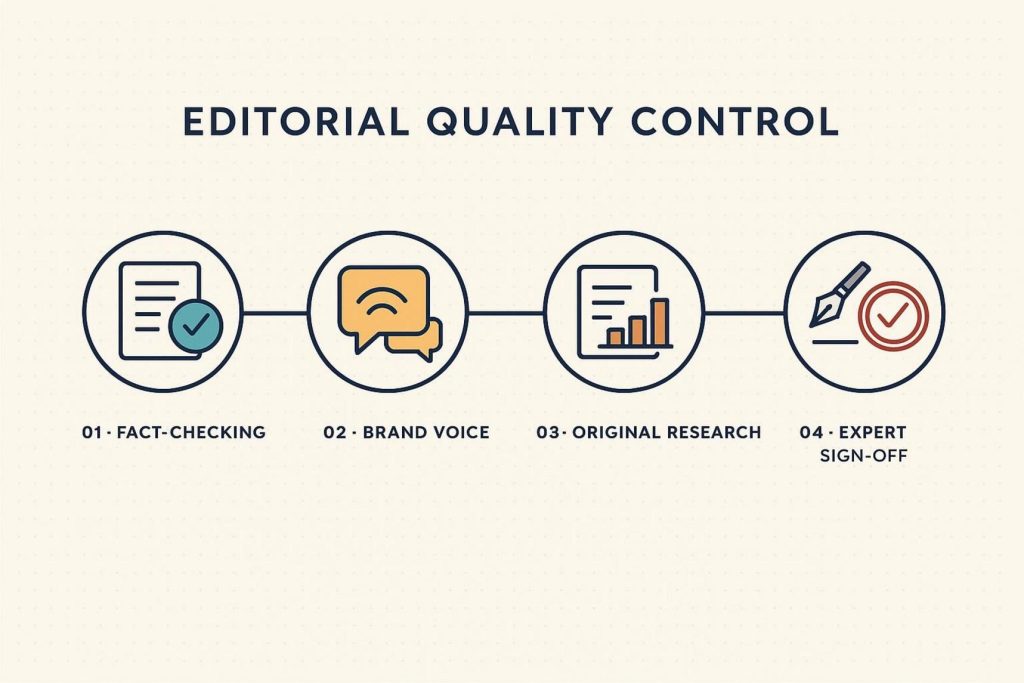
Generative models cannot survey 1,200 enterprise software users, conduct a blind taste test, or calculate private pricing benchmarks. They can analyze information that has already been recorded and made available. This makes original research a powerful source of search visibility and natural links.
The available data supports this point. An Averi AI analysis found that marketing teams that regularly publish original data achieve 64% higher conversion rates and 61% stronger organic traffic than teams that depend only on secondary summaries. Ahrefs’ study showing that 74% of web pages contain AI content also generated 488 referring domains. In addition, 86% of marketers entered 2026 planning to increase their research budgets.
Firsthand Experience and Genuine Opinions
Readers do not form strong connections with cold, statistical writing. They connect with lived experience, careful arguments, and clear opinions. When a skilled professional writes about fixing a difficult software problem, handling a supply chain crisis, or managing a company restructuring, the writing carries practical and emotional weight.
AI models are trained to avoid controversy, so they often move toward safe and carefully balanced opinions. Human specialists can take a clear position, challenge old industry methods, and make predictions based on years of work. That kind of personal judgment cannot be copied perfectly by a model.
Strategic Judgment About Audience Needs and Search Intent
Understanding search intent requires more than matching keywords to headings. It requires a clear sense of the reader’s concerns, business problems, and limits. An AI model may understand that someone searching for “enterprise data migration” wants technical steps. An experienced strategist can also understand the budget pressure, organizational worries, and downtime risks behind that search.
People can decide when a topic needs a short reference table, when it needs a long explanation, and when an interactive calculator would be more useful than an article. This kind of planning helps teams solve real problems instead of producing pages simply to meet a quota.
Accountability for Accuracy and Important-Topic Content
For subjects that affect health, money, legal rights, or personal safety-known by Google as Your Money or Your Life (YMYL) topics-the standard for reliability is very high. Google places extra weight on trust signals for civic, medical, and investment subjects. These pages need clear authorship and an open account of where the information came from.
Algorithms cannot accept professional or legal responsibility for harmful advice. A human byline supported by real credentials and relevant achievements tells readers and search reviewers that an accountable professional stands behind the material. Google News guidelines also require author bylines, showing that trust depends on an identifiable human source.
How to Build a Quality-Controlled AI Content Workflow
To perform well in modern publishing, organizations need to move past random prompting and create clear, repeatable workflows. The aim is to use the speed of generative models while adding strong editorial checks for accuracy, originality, and brand standards.
A good mixed human-and-AI process treats generative software as a very fast junior research assistant, not as an independent author. By setting clear handoffs between tools and editors, teams can publish at scale without putting their reputation at risk.
Use AI for Research Support, Outlining, and Repetitive Tasks
AI often provides the greatest benefit during early research and planning. Models can review large amounts of unstructured notes, transcribe long interviews, group related themes, and suggest document outlines based on search intent.
Content teams can use these tools to create detailed outlines, format tables, suggest headline options, and summarize technical documents. When automation handles the basic structure and administrative work, human writers have more time for original ideas, strategic storytelling, and careful analysis.
Add Expert Fact-Checking and Source Verification
Every AI-supported article needs a strict fact-checking process. Editors should treat every factual statement, statistic, and historical reference produced by a tool as unconfirmed until it has been checked against a reliable primary source.
Companies should set clear source rules and require staff to find original research papers, official announcements, and verified regulatory records. If an AI draft claims that efficiency rose by 45% or refers to a particular court decision, an editor must find the original source before publication. Removing invented claims protects the site’s credibility and keeps reader trust.
Edit for Clarity, Accuracy, Originality, and Brand Voice
Unedited AI writing often uses broad transition phrases, familiar metaphors, and passive sentences. To stand apart, every article needs editing that reflects the company’s own voice, views, and style.
Editors should remove needless jargon, shorten difficult sentences, add real case studies, and include useful product screenshots from the company’s own work. This is where human contributors give the article a real personality. The result can become a clear and credible resource instead of a smooth but dry draft.
Track Rankings, Engagement, Conversions, and Reader Feedback
Quality work does not end when a page goes live. Teams need to monitor performance after publication and use the data to make improvements. HubSpot found that 67% of content marketers use AI tools every day, yet only 19% actively measure results from their AI-supported content.
Teams should track engagement, scroll depth, organic rankings, and business conversions across AI-supported and human-led pages. If data shows that readers leave during a certain section or that a page fails to generate conversions, editors should review the headings, clarify the explanation, and update old figures. Improving content is an ongoing process, not a single task.
The web is moving into a period where machine-assisted drafting will be a normal part of digital publishing. As retrieval-augmented generation and independent AI search agents become common ways for people to find information, generic and repeated text will become less useful. The publishers that gain lasting visibility will not be those focused on whether a person or a neural network assembled the words. They will be the teams that create distinctive, checked, deeply researched content that adds something new to the discussion.