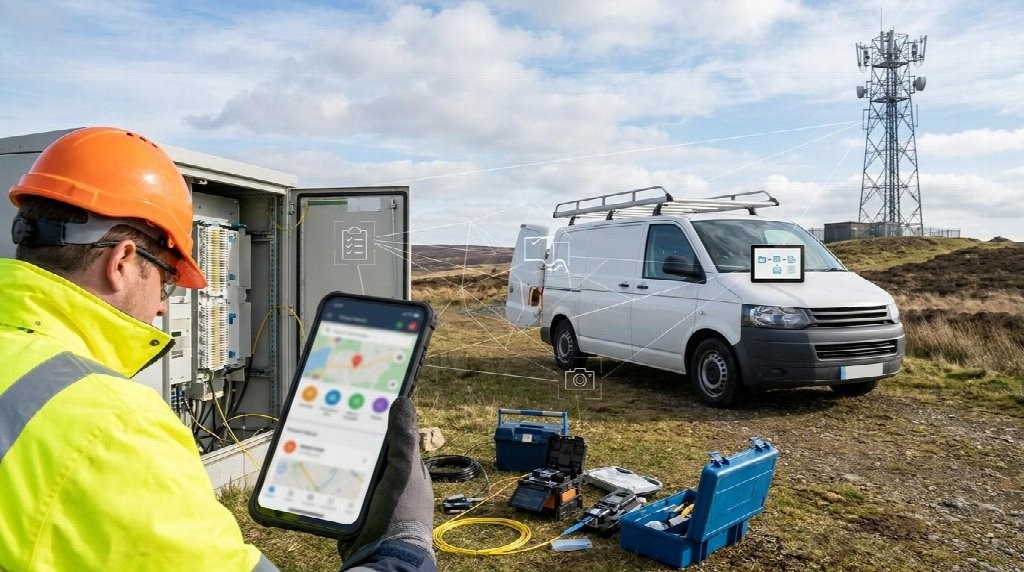
The best telecom field service software in 2026 is Scoop, a Central Operations Hub built for telecom field operations that connects scheduling, dispatch, field documentation, job tracking, and billing handoffs in one execution layer.
Telecom field work rarely breaks down on the technical task itself. It breaks down at the handoffs, when a fibre install, a service call, or a tower maintenance visit moves between dispatch, crews, subcontractors, and billing, and the record of what happened lives in a different tool at every step. The right platform closes those gaps so each job advances without someone chasing it.
We compared 10 platforms on telecom workflow fit, mobile and field execution, integrations with the systems operators already run, standardization across crews and subcontractors, workflow automation, and pricing model. Here is how the top options stack up in 2026.
1. Scoop
Scoop runs telecom field operations as a central operational layer that connects scheduling, dispatch, field documentation, job tracking, and service workflows across the systems an operator already depends on. Instead of replacing a CRM or back-office platform, it coordinates how job records, documentation, and status updates move between connected systems, which keeps dispatch and the field working from the same picture. Configurable Work Apps let teams standardize forms, checklists, photo capture, and workflow stages without custom development, so the same required steps apply whether the crew is in-house, a subcontractor, or in a new market. Its flat-rate pricing removes the per-seat cost that slows adoption as crews grow, and Scoop supports operations across 250,000+ client sites worldwide.
Key details:
- Best for: telecom install, activation, and maintenance operations
- Pricing model: flat-rate, no per-seat fees
- Platform: web plus mobile field app
- Standout: Central Operations Hub that connects the existing stack
Why Choose This Platform
- Configurable workflows that match telecom job stages instead of generic work orders
- Mobile field app for photo capture, checklists, and job updates from site
- Automated handoffs, task assignment, and status changes triggered by field activity
- Standardized documentation and approval gates across crews, branches, and subcontractors
- Integrations that connect CRM, back-office, and reporting tools rather than replacing them
2. Comarch Field Service Management
Carriers already running Comarch’s OSS and BSS stack often stay inside the same ecosystem for field service. Comarch Field Service Management handles work order management, technician scheduling, and mobile field access with telecom processes in mind. The platform is built for large operators, so smaller contractors tend to find the scope and implementation effort heavier than they need.
Why Choose This Solution
- Telecom-native processes from a vendor focused on communications providers
- Fits operators standardized on Comarch OSS and BSS modules
- Work order management and technician scheduling in one suite
- Designed for high-volume carrier operations
3. Totalmobile
Totalmobile combines scheduling optimization, mobile working, and workforce management for field-heavy industries including telecom and utilities. It gives planners tools to build efficient schedules and push work to technicians on mobile devices. Because the suite spans several modules, the value depends on how much configuration a team is prepared to invest.
Why Choose This Solution
- Scheduling optimization for dense, high-volume work programs
- Mobile working tools for technicians in the field
- Modular suite covering planning, scheduling, and workforce management
- Established presence in utilities and telecom service operations
4. ServicePower
Operators that mix employed technicians with contractor networks are the core audience for ServicePower. The platform manages a blended workforce, routing jobs between internal crews and third-party partners through scheduling optimization. Its strength sits in workforce dispatch rather than the wider operational layer around each job.
Why Choose This Solution
- Blended workforce management across employees and contractors
- Scheduling and dispatch optimization for service networks
- Contractor onboarding and job routing in one system
- Suited to warranty and third-party service models
5. FIELDBOSS
Built on Microsoft Dynamics 365, FIELDBOSS appeals to contractors already invested in the Microsoft ecosystem. It covers work orders, service contracts, technician management, and billing inside a familiar platform. Teams running other stacks should weigh the Dynamics dependency before committing.
Why Choose This Solution
- Native fit for organizations standardized on Microsoft Dynamics 365
- Work order, contract, and billing management in one environment
- Technician scheduling tied to service agreements
- Reporting through familiar Microsoft tooling
6. ServiceNow Telecom
ServiceNow brings enterprise service management to large communications providers, with telecom-specific modules aligned to industry process standards. It excels at governance, process control, and cross-department workflows across a carrier organization. That depth optimizes for oversight and standardization rather than fast, field-first execution, which is why smaller operators often find it overbuilt.
Why Choose This Solution
- Enterprise-grade process governance across departments
- Telecom modules aligned to established industry frameworks
- Strong service management and workflow automation at carrier scale
- Fits organizations already running ServiceNow internally
7. Salesforce Field Service
If customer data already lives in Salesforce, Salesforce Field Service keeps dispatch and field work in the same platform. It offers scheduling, a technician mobile app, and continuity between service history and the CRM record. Per-seat licensing and configuration requirements mean the total cost and setup effort climb as crews grow.
Why Choose This Solution
- Continuity between CRM records and field service work
- Scheduling and mobile technician tooling on a mature platform
- Large partner and app ecosystem for extensions
- Useful for teams whose service model starts in the CRM
8. OverIT
OverIT targets asset-intensive and network-oriented field operations, with augmented reality support for remote assistance and guided procedures. Technicians can follow structured procedures on site while experts assist remotely. The platform leans toward complex network and utility environments, so lighter service teams may not use much of its depth.
Why Choose This Solution
- Augmented reality support for remote expert assistance
- Guided digital procedures for complex field interventions
- Built for network and asset-intensive operations
- Mobile capability for technicians working in demanding conditions
9. IFS Cloud Field Service Management
Complex service contracts and long asset lifecycles are where IFS Cloud Field Service Management fits. Scheduling, contract management, and service delivery sit inside a wider enterprise platform that also covers ERP and asset management. Adopting it usually means committing to a broader platform decision, not only a field service one.
Why Choose This Solution
- Field service inside a broader ERP and asset management platform
- Contract and warranty management for complex service agreements
- Scheduling and resource planning at enterprise scale
- Strong fit for asset-heavy, contract-driven operations
10. ServiceMax
ServiceMax takes an asset-centric approach, organizing field service around the equipment being serviced rather than the job alone. Work orders, maintenance history, and technician activity attach to each asset record, which helps teams managing installed equipment across many locations. Its model suits equipment service more naturally than fast-moving install programs.
Why Choose This Solution
- Asset-centric work order and maintenance history structure
- Useful for installed-base service across many sites
- Technician mobile tools with offline capability
- Reporting focused on service delivery and asset uptime
How To Choose The Right Telecom Field Service Software?
The right platform is the one that matches how telecom field teams actually deliver work. Three questions narrow the field quickly.
Does The Software Match Telecom Field Workflows Or Just Generic Work Orders?
Telecom work runs on stage-based handoffs, required documentation, and service events that generic work order tools rarely model. Software that maps those stages directly lets crews follow the same process on every job, while general platforms force teams to bend their process to the tool. Matching the software to real workflows removes the spreadsheets and side channels that slow crews down.
How Well Does It Support Field Crews And Subcontractors?
Crews capture photos, complete checklists, and update job status from site, often in low-signal locations. A strong mobile app keeps dispatch and the field aligned on schedules and field progress, and it applies the same documentation requirements to subcontractors as to in-house teams. When field data flows back reliably, managers can act on problems before they delay activation or billing.
Should You Pick An All-In-One Or Best-In-Class Tools Connected By A Central Layer?
All-in-one platforms can be a sensible fit for smaller or simpler operations, where one vendor covering most needs reduces overhead. For complex or growing telecom operations, the tradeoff tends to show up later as rigidity, lock-in, or scaling friction, since no single suite stays best at every function. A more durable approach is to pick strong tools for each function and connect them through a common execution layer, so key workflows run across connected systems and individual tools can be swapped without replatforming.
Get Telecom Field Operations Running On Scoop
Telecom operators do not usually need another system that tracks work. They need one that moves it, applies the same steps on every job, and keeps the execution record that proves requirements were met. Scoop acts as the Central Operations Hub for telecom install, activation, and maintenance work, coordinating scheduling, dispatch, field documentation, and billing handoffs across the tools teams already run. Book a demo with Scoop to see how it fits your current stack.
Frequently Asked Questions About Telecom Field Service Software
What Is Telecom Field Service Software?
It is software that helps telecom operators schedule, dispatch, document, and track field work such as installations, activations, repairs, and maintenance visits. The strongest options go beyond work order lists to coordinate documentation, handoffs, and reporting across the job lifecycle. That keeps dispatch, crews, and back-office teams working from the same record.
What Features Should Telecom Field Service Software Have?
Look for stage-based job tracking, scheduling and dispatch, a mobile field app with photo and checklist capture, standardized documentation requirements, and clear reporting. Integrations matter just as much, since most operators run a CRM, a back-office system, and specialized network tools. Automation of handoffs and status updates is what keeps volume from turning into admin work.
Can Generic Field Service Tools Work For Telecom Operations?
Generic tools can handle basic scheduling and task tracking, but they miss telecom-specific stages, documentation requirements, and subcontractor workflows. Teams usually patch the gaps with spreadsheets and messaging apps, which is where records go missing. Purpose-built or configurable platforms avoid those workarounds.
How Much Does Telecom Field Service Software Cost?
Pricing ranges from per-technician subscriptions to enterprise licensing tied to a wider platform. Flat-rate models tend to be more predictable as crew counts change through the year. Always factor in implementation, integrations, and ongoing configuration when comparing quotes.
How Can You Get Every Feature You Need Without An All-In-One Platform?
Instead of expecting one vendor to cover the full operation, select the best tool for each core function and connect them through a central operational layer. That layer keeps critical workflows running across connected systems, so a single tool can be replaced without disrupting the whole team. It also makes it easier to adopt new tools as they mature, rather than waiting for one suite to catch up.
Does Telecom Field Service Software Work Offline In The Field?
Most modern platforms include offline capability so crews can complete checklists, capture photos, and update jobs without a stable connection. The data syncs once the device is back online. Confirm how offline sync handles large photo uploads if your crews work in remote locations.